
How to Search Clark County Court Records
Most public Clark County Court searches go through the Eighth Judicial District Court Odyssey Portal Smart Search. The portal covers civil, adult criminal, family domestic, juvenile, and probate cases filed in the District Court. Sealed cases and exempt information will not appear. Justice Court, Municipal Court, marriage records, and jail custody live in other systems, and each has its own search tool.
Before you start, gather the case number if you have one, or a party name in Last, First Middle, Suffix order. A date of birth or a date range can narrow a wide result list. Anonymous users complete a CAPTCHA. Document purchase, attorney access, and pro se sealed case access have their own links from the portal landing page.
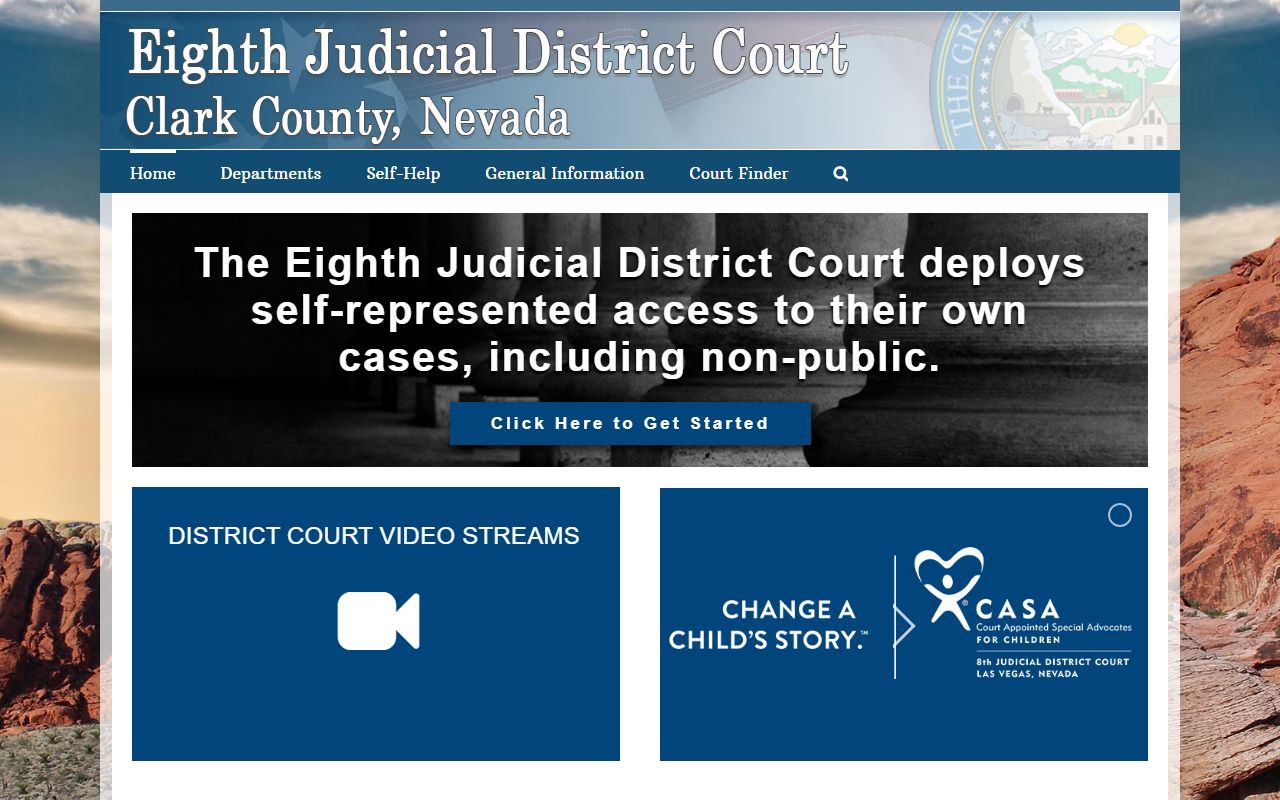
The Eighth Judicial District Court front door at clarkcountycourts.us opens out to the portal, the Clerk page, judicial departments, the Probate Department, and the Specialty Courts page. The image below shows the public landing the court directs first-time visitors to.
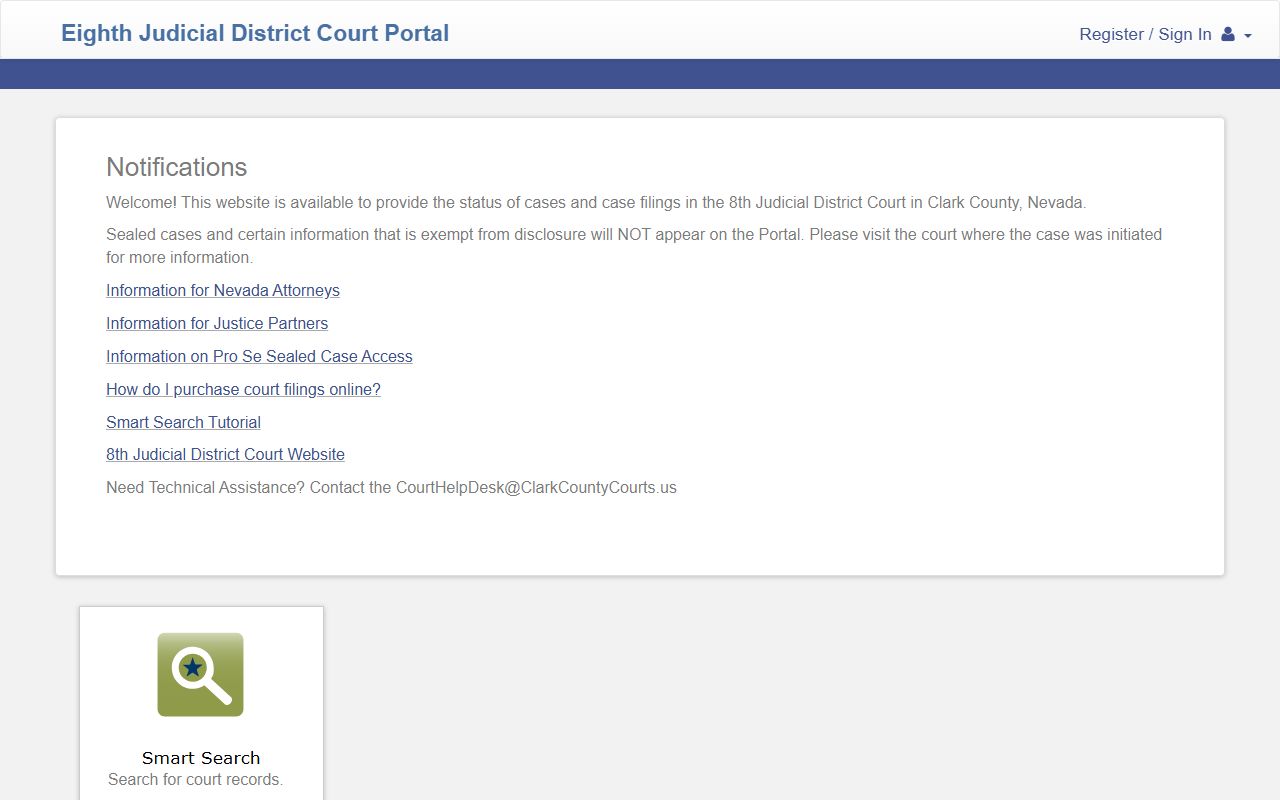
The same court runs the Odyssey Portal at clarkcountycourts.us/Portal, which surfaces notices, document purchase steps, and the Smart Search launch button shown below.
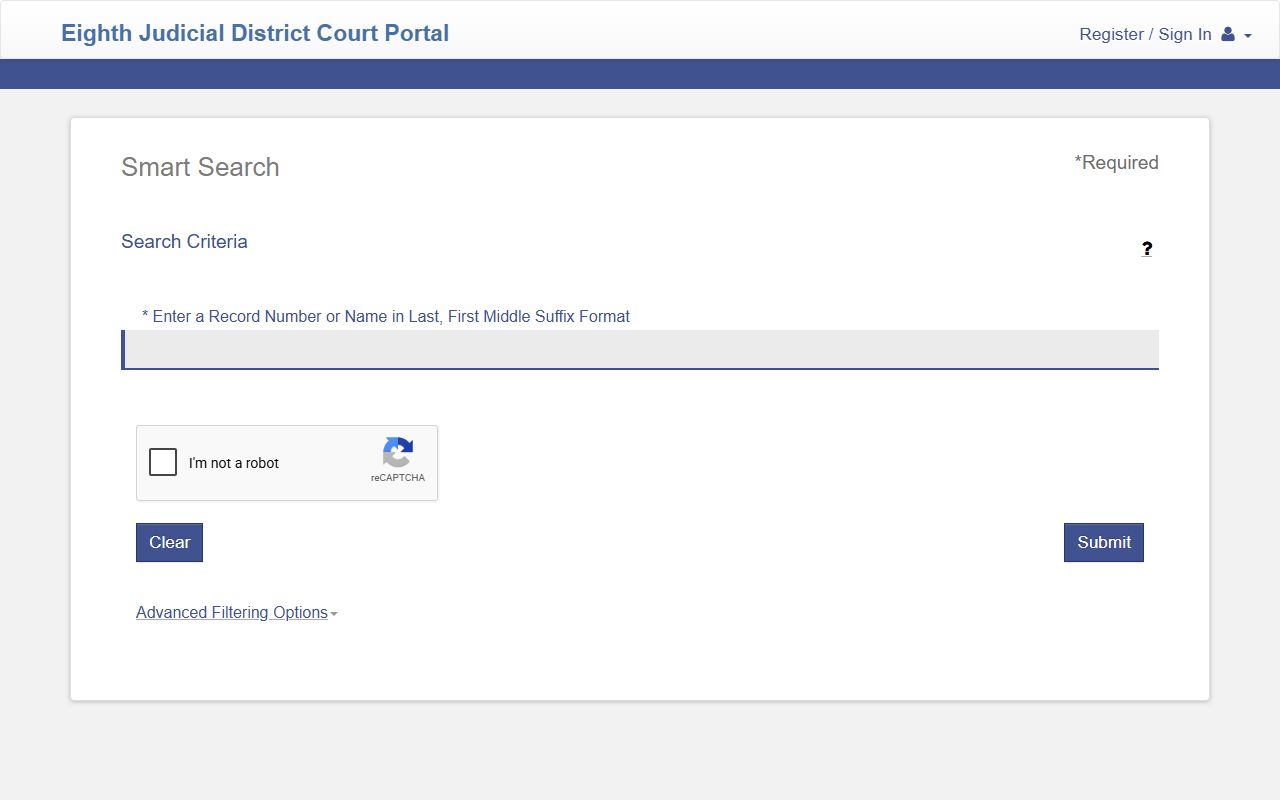
The portal lays out the search itself on the Smart Search dashboard. Use the steps below for a basic search.
- Open the portal at clarkcountycourts.us/Portal and read the notices about sealed cases and exempt information.
- Click Smart Search or go to clarkcountycourts.us/Portal/Home/Dashboard/29.
- Enter a record number, or a name in Last, First Middle, Suffix format. The field accepts up to 100 characters.
- Complete the reCAPTCHA. Anonymous public access needs it. Logged-in users may skip it.
- Open Advanced Filtering Options to narrow by case type, case status, file date range, or judicial officer.
- For a business search, pick Filter by Search Type, choose Business Name, type the company, and click Submit.
- Submit the search. If the result set is too wide, add a date of birth, file date range, or case type filter.
- Open a case to view status, parties, and filings. Use the document purchase link when a file is needed.
- If a case is sealed or juvenile-restricted, the portal may show nothing. Contact the court where the case began.
The Smart Search form itself is captured below. Field-level details follow later on this section of the site.
For a deeper walkthrough, the dedicated Clark County court records page covers each search field, sample case fields, and how to ask for a certified copy.
The Clark County Judicial System
The Nevada court system uses four levels for Clark County matters. The Nevada Supreme Court sits at the top. The Nevada Court of Appeals reviews most appeals first. The Eighth Judicial District Court is the general jurisdiction trial court for Clark County. Justice Courts and Municipal Courts are the limited jurisdiction courts. District Courts come from NRS Chapter 3. Justice Courts come from NRS Chapter 4. Municipal Courts come from NRS Chapter 5.
Case flow: Justice Court › District Court › Nevada Court of Appeals › Nevada Supreme Court
| Court | Jurisdiction | Case Types |
|---|---|---|
| Nevada Supreme Court | Final state appellate review | Appeals from the Court of Appeals and direct review where law permits |
| Nevada Court of Appeals | Intermediate appellate review | Most civil and criminal appeals from District Court |
| Eighth Judicial District Court | General jurisdiction trial court for Clark County | Felony, family, civil, juvenile, probate, guardianship |
| Justice Court (Las Vegas, Henderson, North Las Vegas, Boulder City, Mesquite) | Limited jurisdiction township court | Misdemeanors, traffic, small claims, eviction, protection orders, felony preliminary hearings |
| Municipal Court (Las Vegas, Henderson, North Las Vegas, Boulder City, Mesquite) | City court | City ordinance, misdemeanor, traffic and parking |
Clark County is the largest district in the Nevada court system. Nevada uses District Courts, not a separate County Court at Law layer. Probate is a District Court docket. Family work is heard at the Family Courts and Services Center. The Las Vegas Justice Court shares a building with the District Court at the Regional Justice Center.
Clark County Courthouses
Clark County court business is split among four downtown and central facilities. Knowing which one handles a case stops most wasted trips. The Regional Justice Center is the main District Court building. The Family Courts and Services Center on North Pecos handles family and juvenile cases. The Clark County Detention Center houses people in custody. The County Clerk Marriage License Bureau is on East Clark Avenue.
Regional Justice Center
200 Lewis Avenue
Las Vegas, NV 89101
Eighth Judicial District Court
Family Courts and Services Center
601 North Pecos Road
Las Vegas, NV 89155
Family, juvenile, custody
Clark County Detention Center
330 South Casino Center Boulevard
Las Vegas, NV 89101
Main county jail
A fourth key spot is the County Clerk Marriage License Bureau at 201 East Clark Avenue, Las Vegas, NV 89101. That office runs marriage licenses and County Clerk services, separate from the District Court Clerk. The Eighth Judicial District Court Clerk page is shown below for reference.
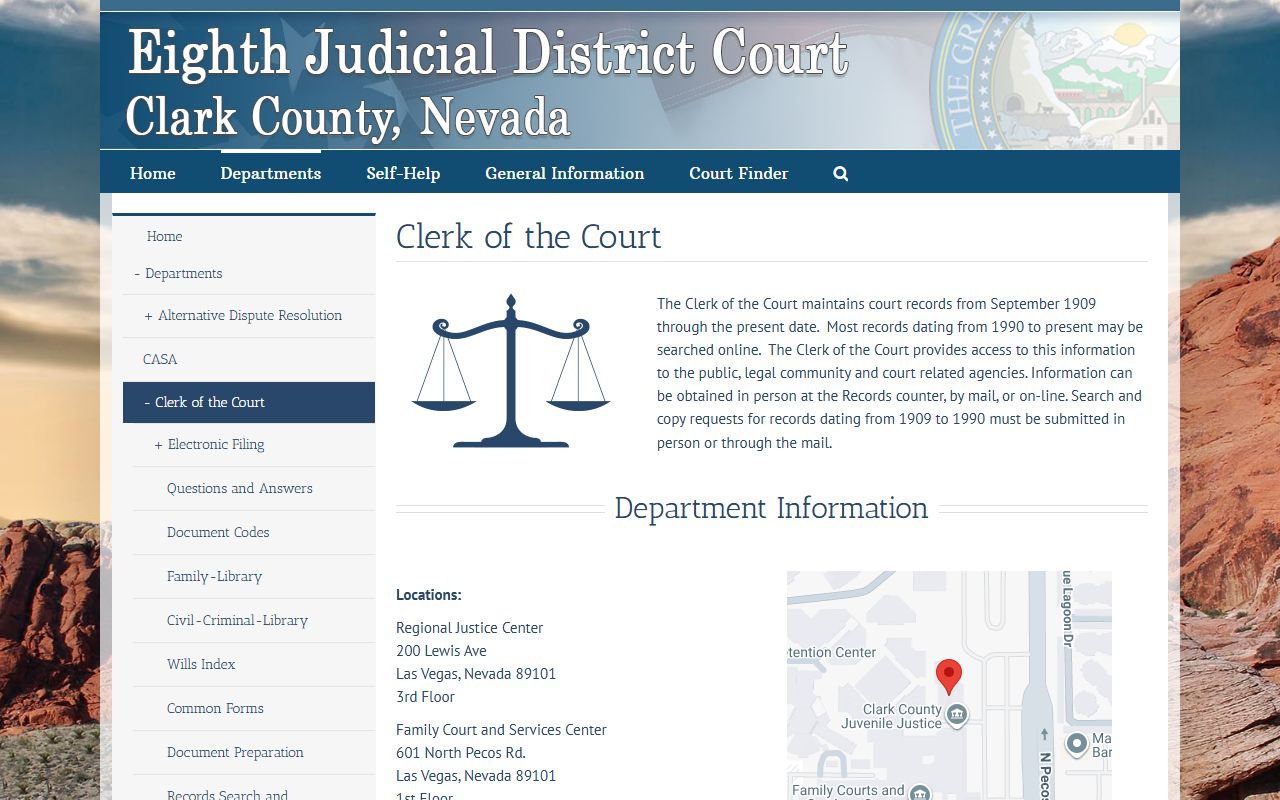
The District Court Clerk page links to record requests, copies, e-filing, and forms. The County Clerk page handles a different set of records, including the marriage license process used by hundreds of thousands of couples every year in Las Vegas.
Types of Court Records Available in Clark County
Clark County court records fall into a few main groups. Civil cases include lawsuits, contract disputes, injuries, business cases, and evictions in lower courts. Criminal cases run from misdemeanors in Justice and Municipal Court up to felony cases in District Court. Family cases include divorce, custody, support, protection orders, and adoption. Probate covers wills, estates, and guardianship. Traffic cases live in Justice or Municipal Court depending on where the citation issued.
Each record type tracks back to a specific court level. Felony complaints, indictments, and informations are District Court records. Justice Court holds misdemeanor and preliminary hearing files. Marriage licenses are County Clerk records under NRS Chapter 122. Divorce cases are District Court family files under NRS Chapter 125. Probate is in the Eighth Judicial District Court Probate Department under NRS Chapter 136.
- Criminal records – arrests, charges, pleas, sentencing, and warrants tied to a case (see arrest records).
- Civil records – complaints, motions, judgments, and orders in non-criminal disputes.
- Family records – divorce, custody, paternity, support, and protection orders (see marriage and divorce records).
- Probate records – wills, estates, guardianship, and trust disputes (see probate records).
- Traffic records – citations, fines, FTA status, court traffic dispositions.
- Juvenile records – restricted under NRS Chapter 62H and rarely public.
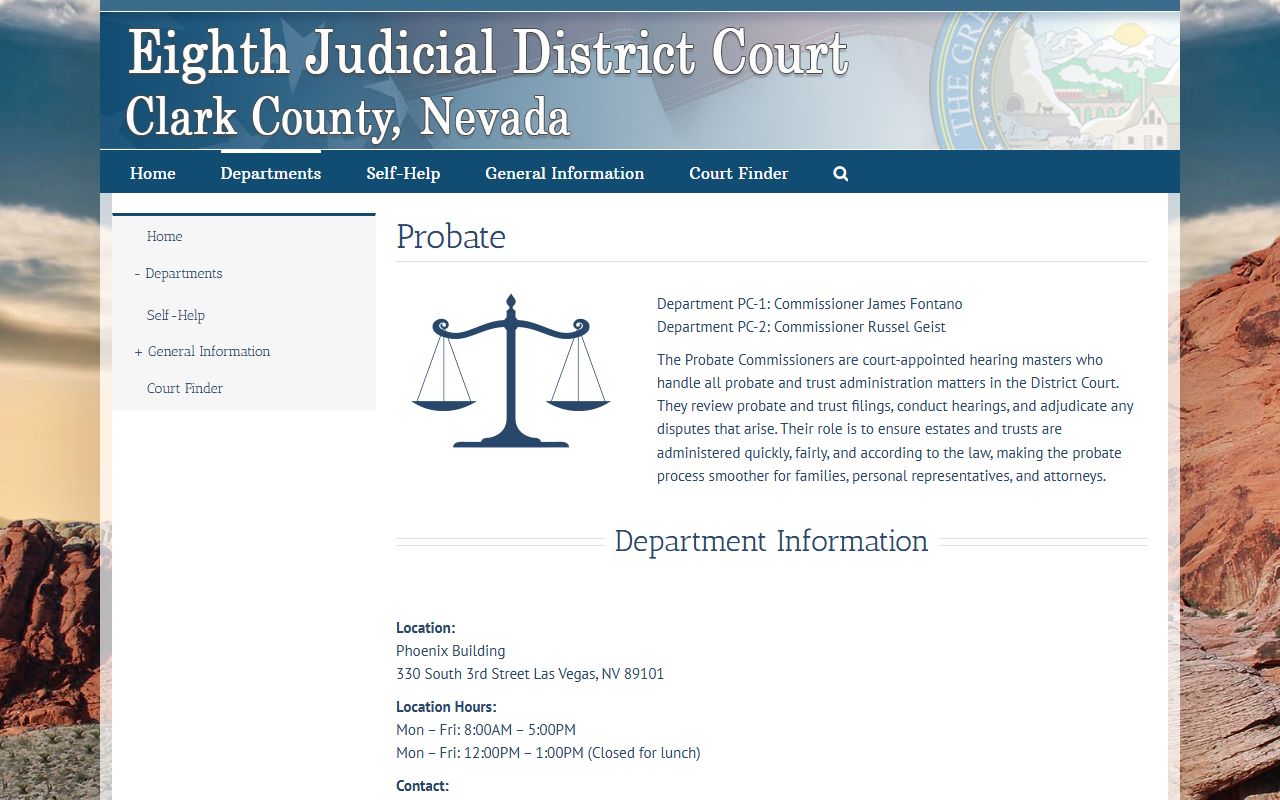
The Probate Department page is shown below. Probate runs as a District Court specialty docket, not a separate court.
What Clark County Court Records Show
Smart Search exposes a standard set of fields once a case opens. Public users see case number, parties, attorneys, judicial officer, file date, case status, and docket events. Some filings can be purchased online. Some are restricted by court order, sealing, or statute.
| Field | What It Shows |
|---|---|
| Case Number | Unique court ID for the file, often year and case type coded. |
| Case Type | Adult Criminal, Civil, Family Domestic, Juvenile, or Probate. |
| Filing Date | Date the case opened in the Eighth Judicial District Court. |
| Parties | Plaintiff, defendant, petitioner, respondent, and business parties. |
| Attorneys | Counsel of record with bar numbers when listed. |
| Judicial Officer | Judge or commissioner assigned to the case. |
| Case Status | Open, Active, Closed, Dismissed, Reopened, Appealed, Warrant, and other internal status values. |
| Docket Events | Filings, hearings, orders, motions, and judgments by date. |
| Sentence or Judgment | Court ruling, plea result, sentence, or money judgment. |
Identifiers like FBI Number, SO Number, State ID Number, and booking number can be used as criminal party filters in the portal. Sensitive data such as Social Security numbers, financial account numbers, victim addresses, juvenile names, and minors' identifiers are redacted from public docket views.
Public Access Laws for Clark County Court Records
Nevada law favors public access. The Nevada Public Records Act in NRS Chapter 239 opens government records unless a statute, court rule, or order makes them confidential. Court records follow this baseline rule along with court access rules and case-specific sealing orders. Fees are generally limited by statute or actual cost, but copy purchases and certified copies follow court clerk fee schedules.
Key Statutes:
NRS 239.010 – Nevada public books and records are open unless a law makes them confidential.
NRS Chapter 179 – Nevada uses record sealing for most adult criminal cases. Eligibility depends on offense, outcome, and waiting period.
NRS Chapter 179A – State criminal history record rules. Criminal history differs from a court docket.
NRS Chapter 62H – Juvenile records are confidential and rarely public.
NRS Chapter 432B – Child welfare and abuse or neglect records are restricted.
A denied record request can be challenged through statutory remedies and judicial review. Routine requests work better when the case number, parties, file date, and document type are spelled out. The court can ask for ID for certified copies or sealed-case access. See the public records page for a request walkthrough.
Records That Are Restricted or Confidential
Some records are not open even when the case is real. Juvenile delinquency files are confidential under NRS Chapter 62H. Adoption files are sealed under NRS Chapter 127. Mental health and crisis admission records are protected under NRS Chapter 433A. Sealed adult criminal records, search warrants under investigation, grand jury proceedings, and protective order victim information are restricted by statute or court rule.
Nevada law uses sealing rather than expungement for most adult criminal records. The court orders a record sealed after a successful petition under NRS Chapter 179. Authorized parties can still view a sealed file with proper notice. Public sites should not display a sealed case. See the arrest records page for the sealing path.
Specialty Courts in Clark County
The Eighth Judicial District Court runs problem-solving dockets through its Specialty Courts program. The list includes Drug Court, Mental Health Court, Veterans Treatment Court, and reentry and competency programs. Each program uses judicial monitoring, treatment plans, status hearings, sanctions, and graduation criteria. A case usually moves into a specialty docket after a plea or agreement, with input from the prosecution, defense, and treatment providers.
Drug Court targets defendants whose conduct ties to substance use. Mental Health Court serves people with documented mental health needs. Veterans Treatment Court serves eligible veterans, which matters in Clark County given the Nellis and Creech military presence in the region. Specialty courts are not automatic. Eligibility is reviewed by the court and counsel.
Clark County Sheriff and Jail
The Las Vegas Metropolitan Police Department runs jail intake and law enforcement for most of Clark County. LVMPD operates the Clark County Detention Center. The CCDC in-custody search at redrock.clarkcountynv.gov shows current custody. The search accepts one input field, and a name search requires at least two letters of the last name. The screen below shows the basic search form.
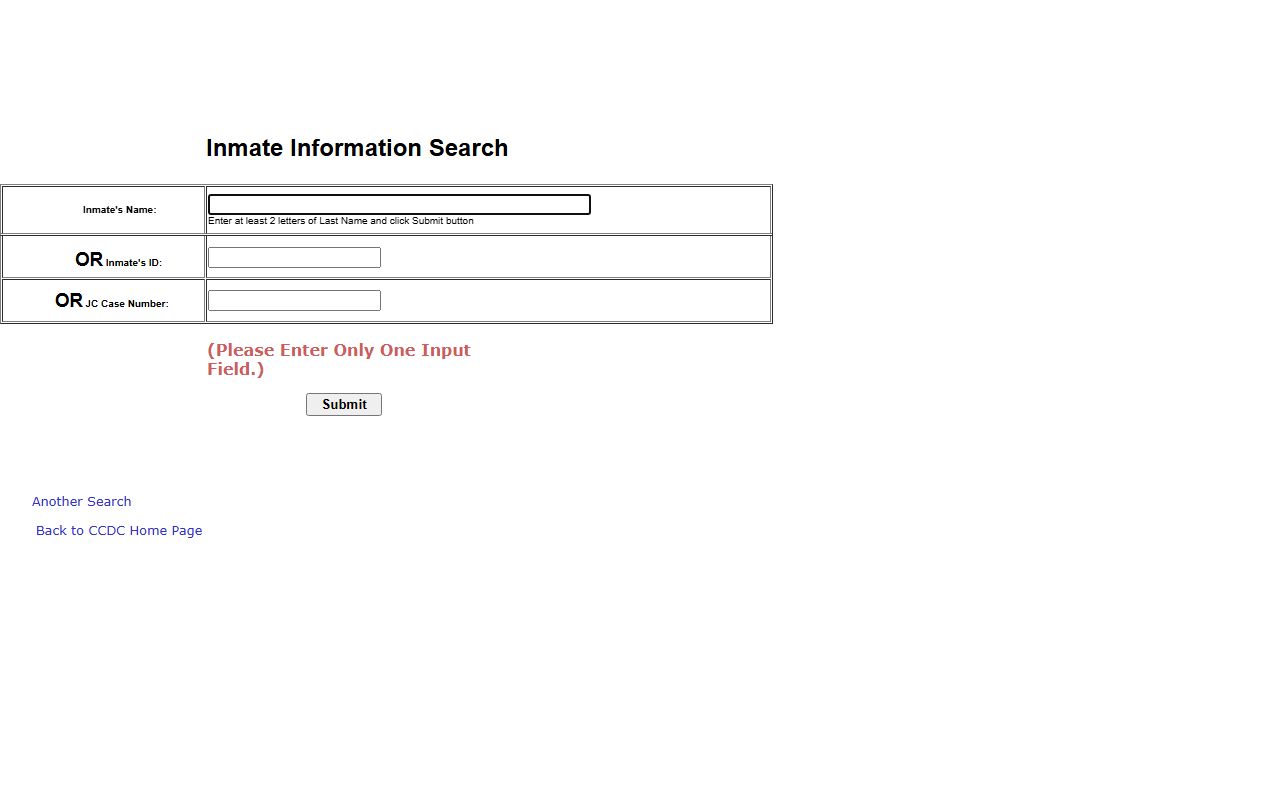
This is a current custody tool, not a full criminal history. A person may have a Clark County case without being in jail right now. Sentenced state inmates show up in the Nevada DOC search. Federal inmates show up in the BOP locator. Full roster details and visitation rules sit on the Clark County inmate records page. Active warrants are best confirmed with the court that issued them, with a path covered on the warrant records page.
Marriage, Divorce, and Probate Records
Clark County splits these records across two clerks. The County Clerk handles marriage licenses and marriage records. The District Court Clerk handles divorce decrees and probate. The County Clerk page at clarkcountynv.gov opens the marriage license, pre-application, and Acclaim search tools. The marriage record search lives at clerk.clarkcountynv.gov. Divorce filings and probate cases are searched through the District Court Smart Search. Full details are on the marriage and divorce page and the probate records page.
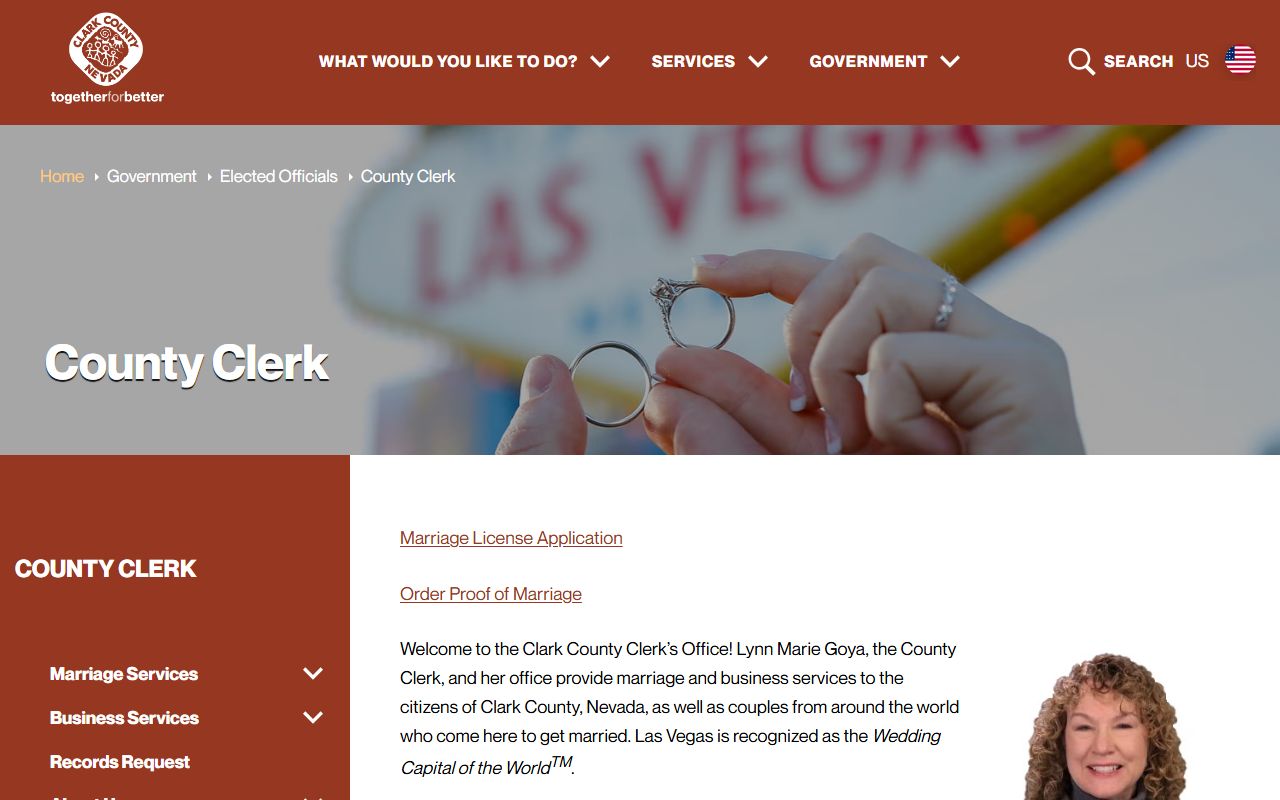
The County Clerk page above is the gateway to marriage license pre-application, marriage record search, certified copy ordering, fictitious firm names, and Secretary of State apostille links. The split clerk system means a divorce case is searched in the District Court Portal even though the marriage license that started it was issued by the County Clerk.
- Testator
- A person who has made a valid will.
- Executor
- A person named in a will to administer the estate.
- Administrator
- A person appointed by the court to administer an estate without a will.
- Intestate
- Dying without a valid will. Nevada law controls how the estate passes.
- Conservator
- A person appointed to manage another adult's finances or property.
- Guardian
- A person appointed to care for a child or for an adult who cannot make decisions.
Clark County Court Records Fees
Clark County court fee schedules are set by the court clerk and by Nevada statute. Plain copy, certified copy, exemplified copy, electronic document purchase, search fee, and filing fee categories all show up across the District Court Clerk, County Clerk, and Justice Court systems. Use the linked fee pages on each office site for the current dollar amounts before paying. Marriage license fees, divorce filing fees, probate filing fees, and small claims fees all change by statute and by court rule.
| Item | Where to verify |
|---|---|
| Plain copy per page | District Court Clerk fee schedule |
| Certified copy per page | District Court Clerk fee schedule |
| Exemplified copy | District Court Clerk fee schedule |
| Civil filing fee | District Court Clerk filing page |
| Marriage license fee | County Clerk marriage license page |
| Certified marriage certificate copy | County Clerk Acclaim order workflow |
| Justice Court small claims and eviction fees | Las Vegas Justice Court fee schedule |
Note: Court clerks update fee schedules without much notice, and electronic document purchase totals can include a per-file charge plus a per-page rate, so confirm the cart total before checkout.
How to Interpret Clark County Court Records
A docket can read like a foreign language. A charge is not a conviction. A motion is a request, not an order. A judgment is the final ruling. A sentence is what the court imposes. An arrest record is not the same as a court record, and neither is a criminal history report from the state. The District Court portal lists case status values that include Open, Active, Closed, Dismissed, Reopened, Transferred, Appealed, Search Warrant Filed, Search Warrant Closed, and Warrant. Each value carries a different meaning for the case.
A criminal history record under NRS Chapter 179A comes from the state records repository and is fingerprint-based. A court record comes from the court file. The two can disagree because they track different events. Always confirm with the issuing court or the state agency before relying on a record for an employment, housing, or licensing decision. Background screening must follow the FCRA.
Accuracy and Record Limitations
Online portals are not the official court file. Data lag is common after a hearing. Sealed and exempt cases do not appear at all. A no-result search does not prove a case never existed. Errors should be raised with the issuing court clerk in writing with the case number, date, and a copy of the inaccurate record.
Note: Confirm dates, dispositions, and party names with the originating court clerk before using an online portal result in a legal, employment, or housing decision.
Self-Help and Legal Aid in Clark County
Clark County has strong self-help resources. The Civil Law Self-Help Center covers small claims, evictions, civil lawsuits, protection orders, garnishment, and judgments. The Family Law Self-Help Center covers divorce, custody, paternity, support, guardianship, and name change. The Nevada Judiciary Self-Help Center covers statewide forms.
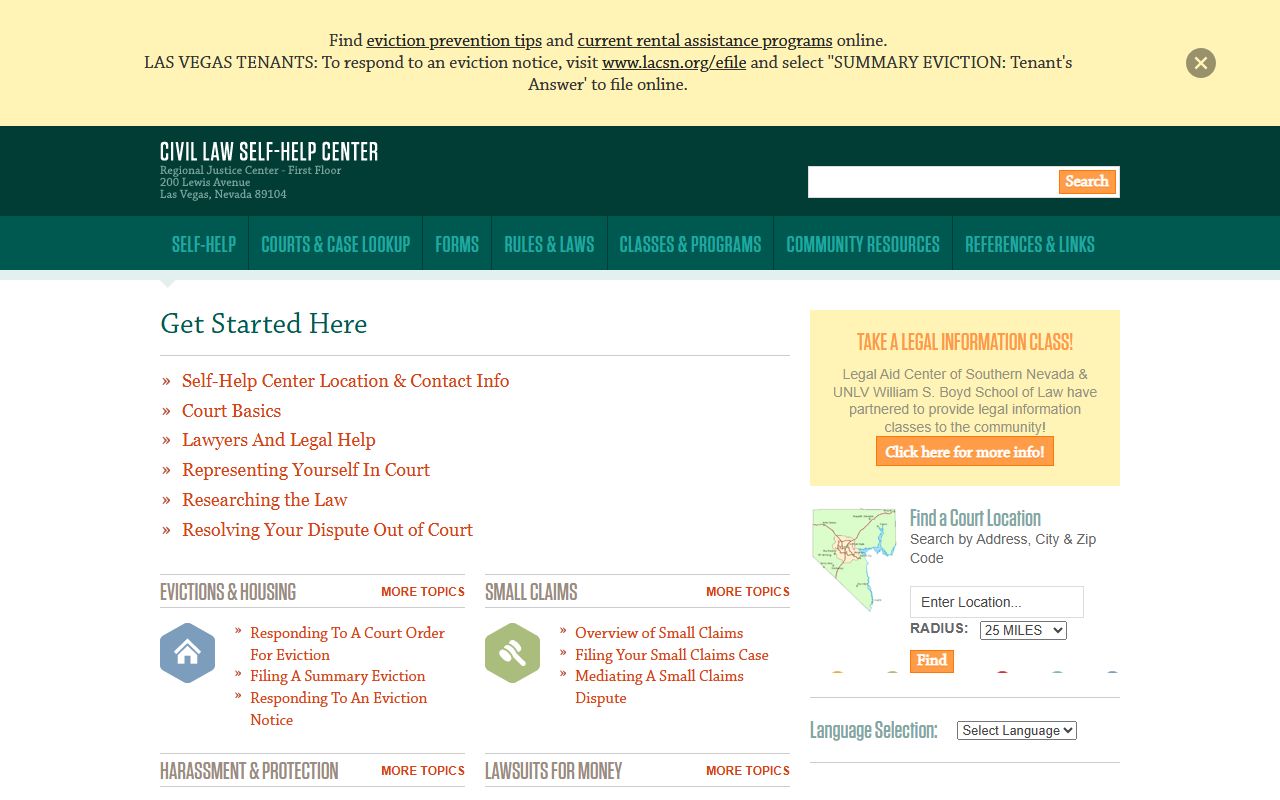
The Civil Law Self-Help Center is the first stop for non-criminal pro se filings. Staff give legal information and forms but not legal advice. The Family Law Self-Help Center handles the bulk of divorce filings by self-represented litigants.
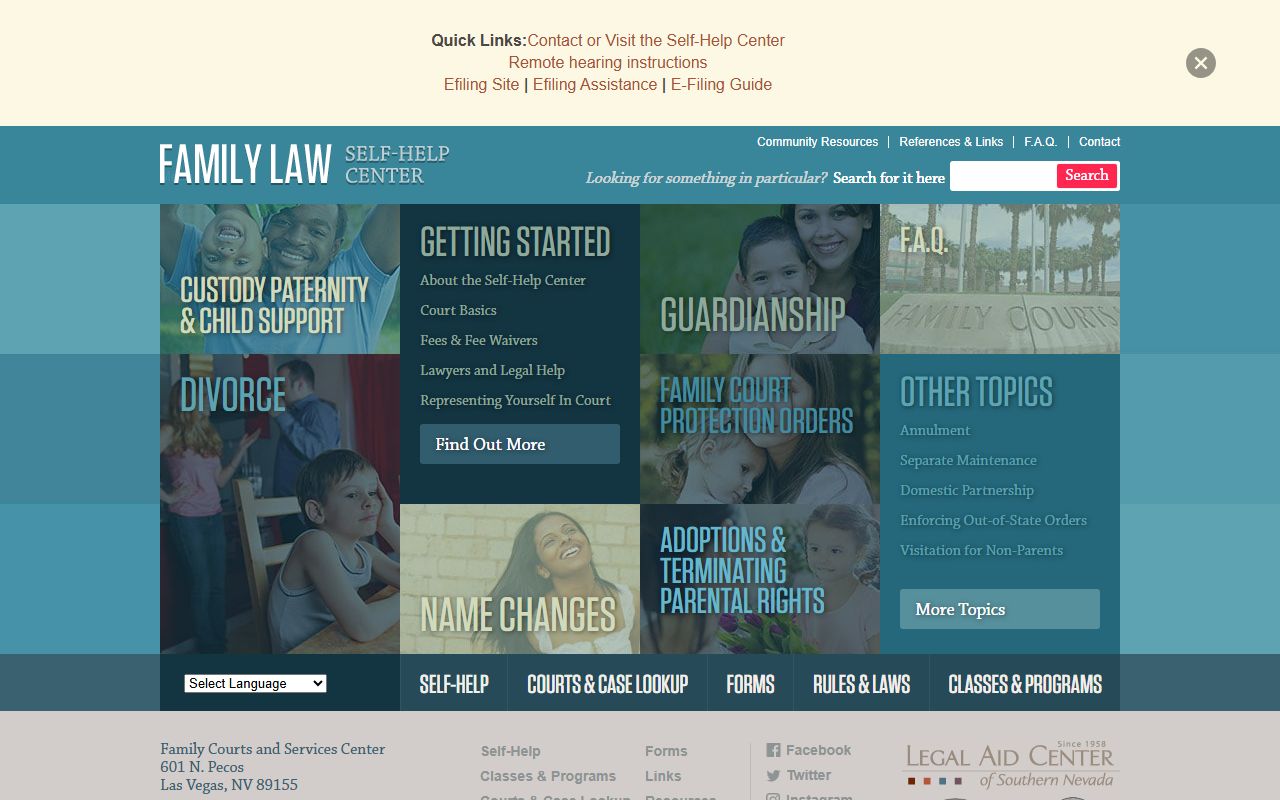
Free legal aid is also available through Legal Aid Center of Southern Nevada, Nevada Legal Services, and the State Bar of Nevada lawyer referral service.
History of Clark County Courts
Clark County was created in 1909, with Las Vegas as the county seat. The court system grew with the city. Today the Eighth Judicial District Court is the largest court district in Nevada. The Regional Justice Center anchors District Court operations near the federal courthouse, the detention center, and Las Vegas City Hall. Family work moved to its own campus at the Family Courts and Services Center on North Pecos Road. The County Clerk became known nationally for Las Vegas marriage licensing volume.
Technology changes have reshaped public access. The Tyler Odyssey Portal opened online docket search and document purchase to the public. The Acclaim system put marriage record search and county records on the web. The CCDC built a public in-custody search. Each shift made it easier to find a case from outside the courthouse, while keeping sealed and exempt files off public screens.
Frequently Asked Questions
How do I search Clark County court records?
Use the Eighth Judicial District Court Odyssey Portal Smart Search. Enter a case number or a name in Last, First Middle, Suffix order. Complete the CAPTCHA if you are not logged in. Use Advanced Filtering Options for case type, file date range, status, or judicial officer. Sealed and exempt cases will not show up. For full steps see the court records page.
Are divorce records handled by the County Clerk?
No. Marriage licenses and marriage records are County Clerk records. A divorce is a District Court family case under NRS Chapter 125 and is searched through the District Court Portal. Certified divorce decree copies come from the District Court Clerk, not the County Clerk marriage bureau.
How do I find someone in Clark County jail?
Use the CCDC Inmate Information Search. Enter only one input field, with at least two letters of the last name, the inmate ID, or a Justice Court case number. Click Submit. The search shows current custody only. For releases and notification options use the released inmates page.
Are warrants searchable on Smart Search?
The Smart Search configuration sets SearchWarrantsEnabled to false. Some case statuses do include Warrant. A no-result search is not proof there is no warrant. The warrant records page covers how to confirm with the issuing court and resolve a bench warrant.
More on the Clark County court records FAQ page.