
Types of Clark County Warrants
Clark County warrants fall into a few clear categories. Each category has a different issuing court, a different reason behind it, and a different process for resolution. Knowing the type is the first step before any search.
A bench warrant is issued by a judge when a person fails to appear, fails to comply with a court order, or violates probation or case conditions. Bench warrants are common in traffic and misdemeanor cases when a defendant misses a Justice Court or Municipal Court hearing. They are also common in family court after a missed support hearing.
An arrest warrant is issued after a court or magistrate reviews probable cause. It authorizes law enforcement to take the named person into custody. Clark County arrest warrants connected to felony charges are issued through the Eighth Judicial District Court process. Misdemeanor arrest warrants are issued at the Justice and Municipal Court level.
A search warrant authorizes a search of a place, a person, or property. Search warrants may be sealed during an active investigation. The District Court Smart Search posts case-status values for Search Warrant Filed and Search Warrant Closed, but the warrant contents may stay restricted. A fugitive or extradition warrant covers out-of-county or out-of-state custody and ties into the U.S. Marshals or other agencies. A traffic or failure-to-appear warrant arises from missed appearances or unpaid citations and points back to the court named on the ticket.
Why Clark County Has No Single Warrant List
Clark County does not run one public website that lists every active warrant. The Eighth Judicial District Court Smart Search configuration sets SearchWarrantsEnabled to false in the inspected public configuration, even though warrant statuses can appear on case results. Justice Courts and Municipal Courts each handle their own warrants. Police agencies hold internal warrant data that is not always available to the public for safety and operational reasons.
That structure means a quick web search is not the right way to confirm a Clark County warrant. The right way is to contact the issuing court directly. For a traffic ticket, the court named on the citation controls the warrant. For a felony case, the Eighth Judicial District Court handles the docket. For a misdemeanor in an incorporated city, the city's Municipal Court is the source.
Note: A clean no-result in any public portal is not proof there is no warrant. Sealed warrants, agency-only data, and lower-court records can all hide a warrant from a casual search.
Clark County District Court Smart Search Limits
The Smart Search at clarkcountycourts.us/Portal/Home/Dashboard/29 is the public access point for District Court cases in Clark County. It shows case status values such as Warrant, Search Warrant Filed, and Search Warrant Closed when those statuses are tied to a District Court case. It is not a stand-alone active-warrant list.
The image below shows the Eighth Judicial District Court Smart Search form, which is the District Court public entry point for case status data in Clark County, Nevada.
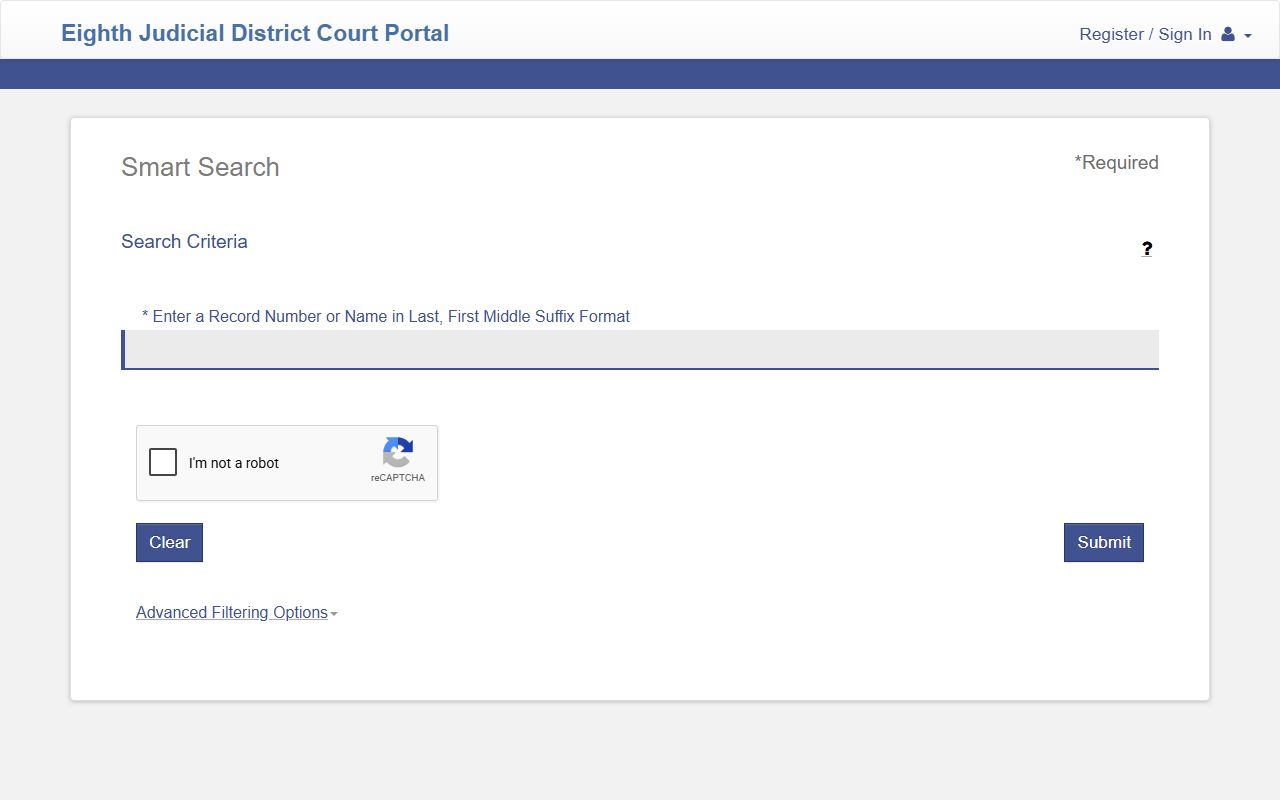
The Smart Search returns case-level records. A user can find a warrant status flag on an open case by running a name or case-number search and reading the case page. The portal's posted notice warns that sealed cases and exempt information will not appear. For a known case number, this is faster than a name search.
Smart Search warrant-related case status values include Warrant, Search Warrant Filed, and Search Warrant Closed. These flags are visible on the case page when present. The Clark County court dockets page covers each case status label in more detail.
Clark County Warrant Record Fields
When a warrant record is visible inside a court file, a standard set of fields appears. The table below lists the fields a user is likely to find on an open Clark County warrant entry, with a short note on what each one shows.
| Field | What It Shows |
|---|---|
| Case Number | Court identifier for the case tied to the warrant. |
| Defendant Name | Name of the person the warrant names. |
| Warrant Type | Bench, arrest, search, fugitive, or failure-to-appear. |
| Issuing Court | District Court, Justice Court, or Municipal Court issuing the order. |
| Issue Date | Date the warrant was issued. |
| Charge or Offense | Underlying alleged offense or order violation. |
| Bail or Bond | Amount, if any, set for release on the warrant. |
| Status | Active, served, recalled, quashed, or closed. |
| Recall or Quash Date | Date the warrant was lifted by court order. |
| Warrant Number | Internal court identifier for the warrant document. |
| Related Hearing | Hearing that resulted in the warrant. |
| Arrest or Return | Booking, custody, or return-to-court information after service. |
Note: Juvenile warrants and sealed warrants are restricted and may not display any fields in a public search.
How to Resolve a Clark County Warrant
The right path to clear a Clark County warrant depends on the type and the issuing court. The general process below is a starting point. Anyone with a felony warrant or unclear status should talk to a lawyer before appearing.
- Identify the issuing court from the citation, case number, notice, or arrest paperwork.
- Search the matching court portal for the case. Do not rely on a generic web aggregator.
- Call the court clerk or your attorney to confirm the warrant is active and check whether a recall calendar exists.
- Ask about walk-in warrant quash hearings, bail or bond requirements, payment methods, and whether counsel is required.
- If surrendering, bring government identification, case paperwork, any prescribed medications, and contact information for family.
- Arrange transportation, childcare, and time off work before going in.
- After resolution, confirm the recall or clearance was transmitted to law enforcement and keep copies of court orders and receipts.
For a felony warrant, the Clark County Public Defender represents eligible defendants once counsel is appointed. Eligibility is set through the court process and a financial screening. Private counsel is also an option. The arrest records page covers the booking process after a warrant is served.
Checking the Clark County Detention Center for Warrant Service
A served warrant ends in a booking at the Clark County Detention Center for most local cases. The CCDC in-custody search at redrock.clarkcountynv.gov/ccdcincustody/incustodysearch.aspx is the right place to check after a known warrant is served. The search accepts inmate name, inmate ID, or Justice Court case number, and only one field at a time.
The image below shows the Clark County Detention Center home page used as the official jail information source for Clark County after a warrant is served.
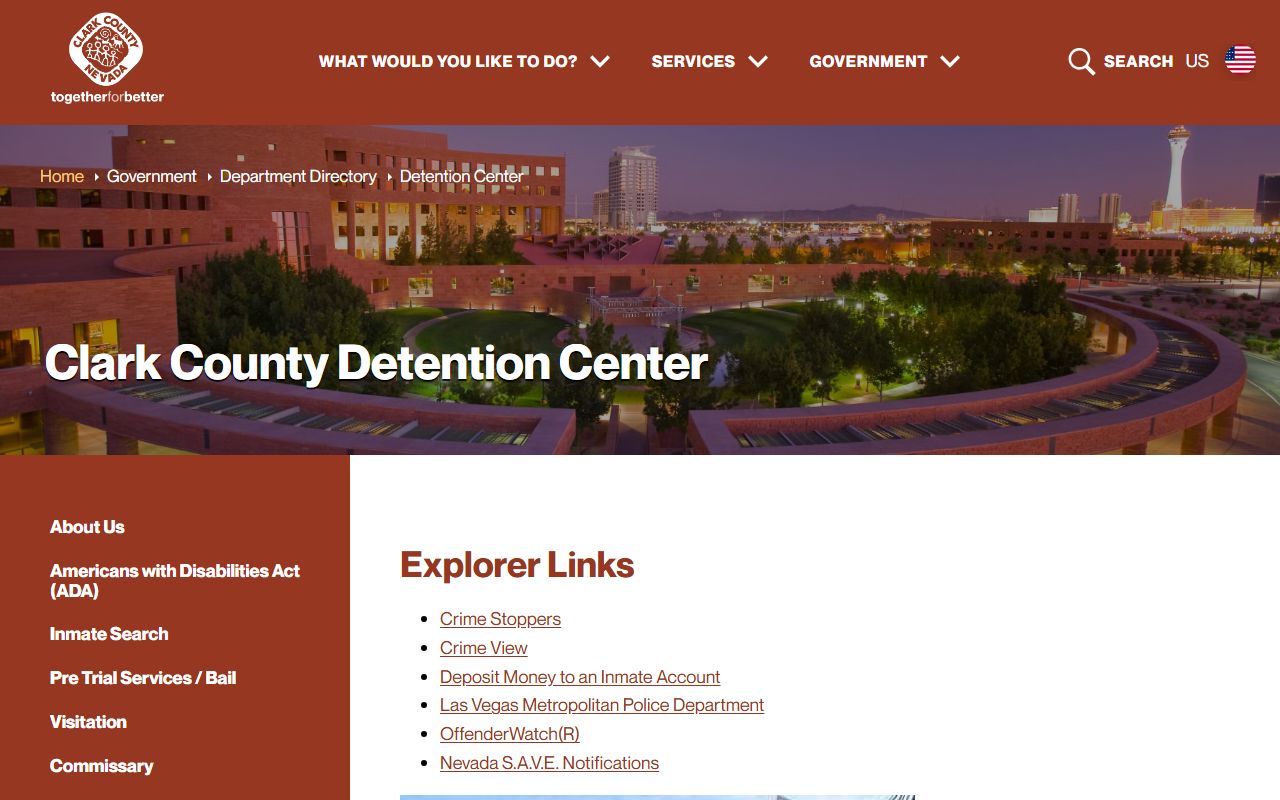
The CCDC search shows current custody only. A person who was served and bonded out quickly may not appear by the time of a later check. For real-time release updates, the released inmates page covers VINELink Nevada and related notification tools.
Bench Warrants for Missed Hearings in Clark County
Bench warrants are the most common warrant type for ordinary Clark County users. They arise from missed court dates, failure to comply with court orders, and probation violations. A missed traffic court date can trigger a bench warrant. A missed Family Court hearing can trigger a bench warrant. A missed civil judgment debtor exam can trigger a bench warrant in narrow situations.
Resolving a bench warrant usually means contacting the issuing court, scheduling a recall hearing, and appearing on the new date. Some Justice and Municipal Courts in Clark County run walk-in calendars for warrant quash hearings on specific days. Confirm the schedule with the court clerk before walking in. A bench warrant on a misdemeanor case can still result in a custody booking if the person is contacted by law enforcement and not voluntarily addressing the warrant.
Civil and family bench warrants tied to support, custody, and protective order matters interact with family-law deadlines. The marriage and divorce records page covers Family Court process. Note: a bench warrant clearance does not automatically clear the underlying case; the case still needs resolution.
Clark County Traffic Warrants and Failure-to-Appear
Traffic warrants are usually issued by a Justice or Municipal Court after a missed court date or unpaid citation. They are not District Court warrants. The court named on the citation controls the warrant and the resolution process. Many Clark County traffic courts allow online payment, online plea, or a contested-trial setting.
A traffic warrant can carry consequences beyond a fine. It can trigger a DMV hold, license suspension, or future arrest. CDL holders face stricter rules. DUI cases route to the criminal-records process and are not standard traffic matters. The traffic court records page covers citation lookup, payment, contesting tickets, and the difference between a court traffic record and the Nevada DMV driver record.
For traffic warrant resolution, contact the court named on the citation, pay or set a hearing, and ask the clerk how the recall is transmitted to law enforcement and DMV.
Clark County Legal Help for Warrant Cases
Self-help and legal aid resources can help with Clark County warrants, especially for users who cannot afford counsel. The Civil Law Self-Help Center covers civil matters and protection orders. The Family Law Self-Help Center covers family-law bench warrants and missed hearings. The Nevada Judiciary Self-Help Center provides statewide forms.
The image below shows the Legal Aid Center of Southern Nevada page used for Clark County civil legal aid.

Legal Aid Center of Southern Nevada provides civil legal help to eligible Clark County residents and runs clinics across several topic areas. Criminal indigent defense is separate and is handled by the Public Defender. The State Bar of Nevada lawyer referral service at nvbar.org can refer private counsel.