
The Eighth Judicial District Court Overview
The Eighth Judicial District Court serves Clark County. It is Nevada's general-jurisdiction trial court for the county and the busiest district in the state. The court handles civil disputes, felony criminal cases, family matters, juvenile cases, probate, and guardianship. Nevada does not use a separate county court at law system; limited matters go to Justice Courts and Municipal Courts instead.
The court is established under NRS Chapter 3, which governs Nevada district courts. The Eighth Judicial District Court runs many departments and judges rather than numbered county courts. Civil, criminal, family, juvenile, and probate work is distributed across those departments.
The image below shows the Eighth Judicial District Court judicial departments page, which lists the Clark County District Court departments and judges.
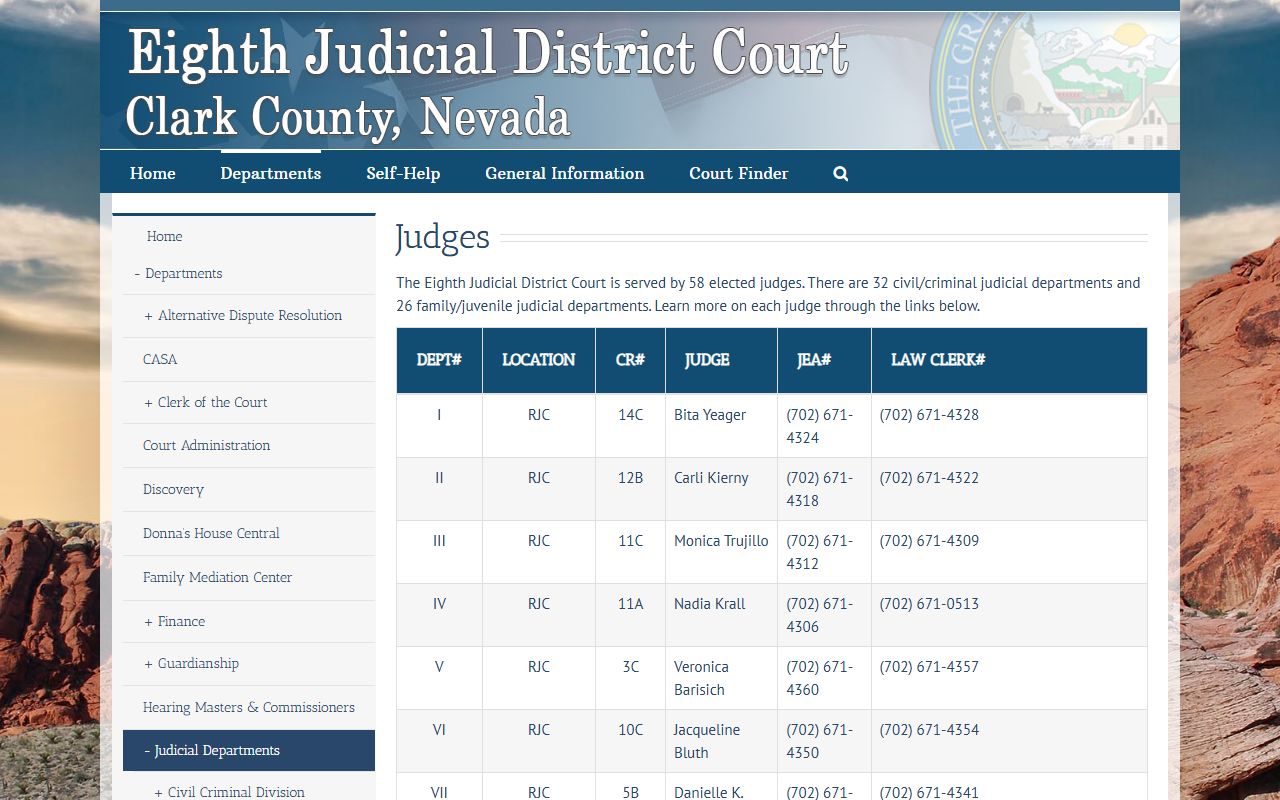
The judicial departments page at clarkcountycourts.us/departments/judicial is the official source for current department and judge assignments, which change over time.
Clark County District Court Facilities
The District Court runs from more than one building. The Regional Justice Center in downtown Las Vegas is the main facility for civil, criminal, and probate trial work. The Family Courts and Services Center on North Pecos Road handles family, juvenile, custody, and dependency matters.
The table below lists the main Clark County District Court facilities, their addresses, and what each one handles.
| Facility | Address | Handles |
|---|---|---|
| Regional Justice Center | 200 Lewis Avenue, Las Vegas, NV 89101 | Civil, criminal, and probate trial departments |
| Family Courts and Services Center | 601 North Pecos Road, Las Vegas, NV 89155 | Family, juvenile, custody, and dependency matters |
The two buildings split the workload. A divorce or custody case is heard at the Family Courts and Services Center. A felony or civil trial is heard at the Regional Justice Center. Knowing which building handles a case stops a wasted trip downtown.
Regional Justice Center
200 Lewis Avenue
Las Vegas, NV 89101
Main District Court facility
Family Courts and Services Center
601 North Pecos Road
Las Vegas, NV 89155
Family and juvenile matters
Clark County District Court Case Types
The District Court handles the full range of general-jurisdiction case types. Each generates its own records and follows its own access rules.
Civil cases cover contract disputes, tort claims, business litigation, real property, and injunctions. Criminal cases at the District Court level cover felony trial proceedings. Family cases cover divorce, custody, support, paternity, and protective orders. Juvenile cases cover delinquency and dependency and are heavily restricted. Probate cases cover wills, estates, and guardianship.
The Smart Search case-type filter exposes Adult Criminal, Civil, Family Domestic, Juvenile, and Probate. The court records page covers each type in detail and lists every search field. The probate records page and the marriage and divorce records page go deeper on those specialized dockets.
District Court vs Justice and Municipal Courts
Clark County has three trial-court levels. The District Court is the general-jurisdiction court. Justice Courts and Municipal Courts handle limited matters. The comparison table below shows how they differ.
| Court | Handles | Statute |
|---|---|---|
| Eighth Judicial District Court | Felonies, civil, family, juvenile, probate | NRS Chapter 3 |
| Justice Courts | Misdemeanors, traffic, small claims, evictions, felony preliminaries | NRS Chapter 4 |
| Municipal Courts | City ordinance and misdemeanor matters | NRS Chapter 5 |
Justice Courts are established under NRS Chapter 4 and Municipal Courts under NRS Chapter 5. Clark County township Justice Courts include Las Vegas, Henderson, North Las Vegas, Boulder City, and Mesquite. The same cities run Municipal Courts for ordinance matters.
How a Case Moves Through the Clark County Court System
A case follows a path through the court system depending on its type. A felony often starts in Justice Court for the preliminary hearing, then binds over to District Court for trial. A civil or family case starts directly in District Court. An appeal moves up into the Nevada appellate system.
The flow for a felony case is: Justice Court preliminary hearing, then bound over to the Eighth Judicial District Court for trial, then appeal to the Nevada Court of Appeals, with final state review in the Nevada Supreme Court. A civil case skips the Justice Court step and starts in District Court when it exceeds the Justice Court limits.
- A limited matter or felony preliminary starts in Justice Court or Municipal Court.
- A felony binds over to the Eighth Judicial District Court for trial-level proceedings.
- A civil, family, or probate case starts directly in District Court.
- A District Court judgment can be appealed into the Nevada appellate system.
- The Nevada Court of Appeals and the Nevada Supreme Court provide appellate review.
The court dockets page covers how each step appears as a docket entry. The warrant search page covers the warrants that can be issued at any stage.
Searching Clark County District Court Records
District Court records are searched through the Eighth Judicial District Court Smart Search at clarkcountycourts.us/Portal/Home/Dashboard/29. The portal provides case status and case filings for the District Court and warns that sealed and exempt cases will not appear.
A user enters a case number or a name in Last, First Middle Suffix format, completes a CAPTCHA if anonymous, and uses Advanced Filtering Options to narrow by case type, status, date, or judicial officer. The portal links to attorney subscription access, justice partner access, pro se sealed case access, and document-purchase instructions.
The court records page walks through the full Smart Search field set, and the Clerk of the Court page covers records requests for documents that are not online.
Clark County Specialty Courts
The Eighth Judicial District Court runs specialty courts for eligible cases. These problem-solving dockets handle substance use, mental health, veteran status, and reentry through treatment and judicial monitoring instead of standard sentencing.
The image below shows the District Court specialty courts page, the source for current Clark County treatment, mental health, veterans, and reentry programs.
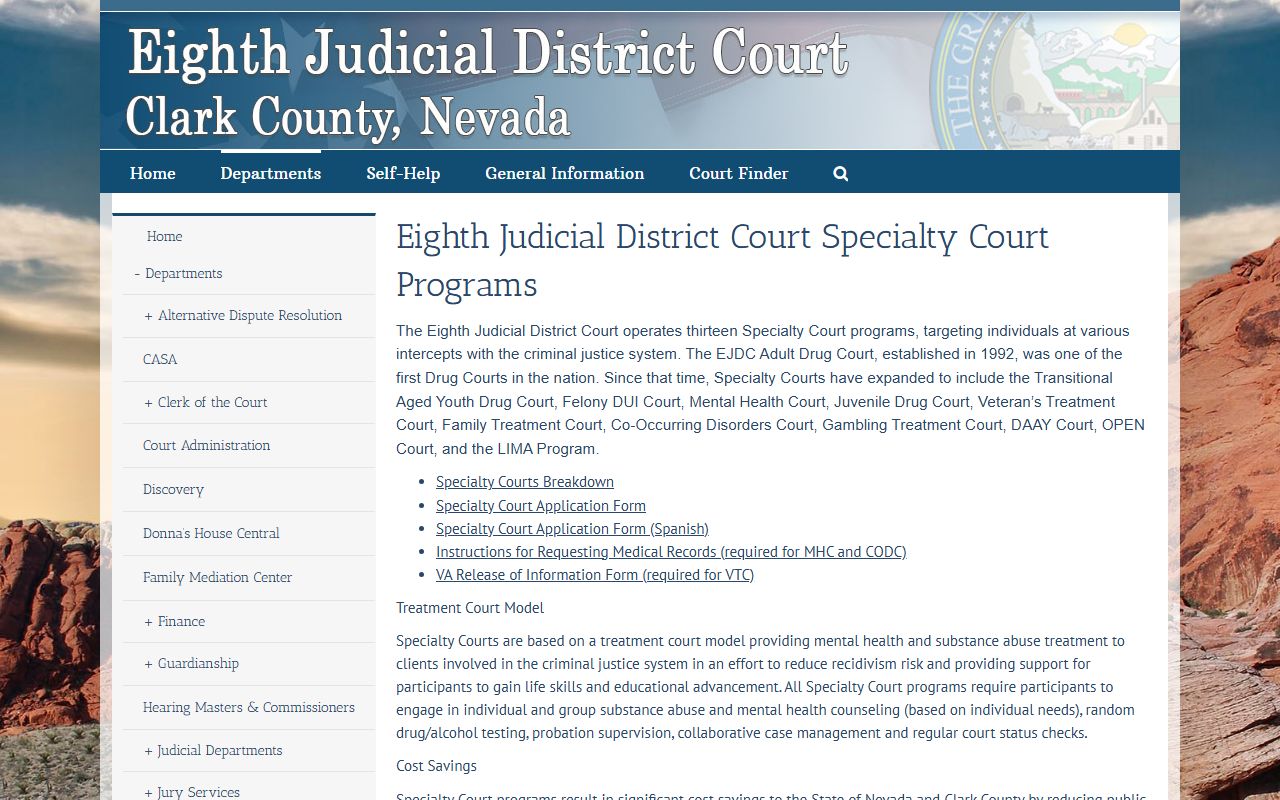
The specialty courts page at clarkcountycourts.us/departments/specialty-courts lists current programs. Eligibility is set by the court, prosecutor, defense counsel, and treatment providers. The arrest records page covers how specialty courts fit into the criminal process.
Appeals From the Clark County District Court
A District Court judgment can be appealed into Nevada's appellate system. The system includes the Nevada Court of Appeals as an intermediate court and the Nevada Supreme Court for final state review. Appeals follow strict deadlines and procedural rules.
The image below shows the Nevada Judiciary site, the source for the Nevada Supreme Court and Court of Appeals.
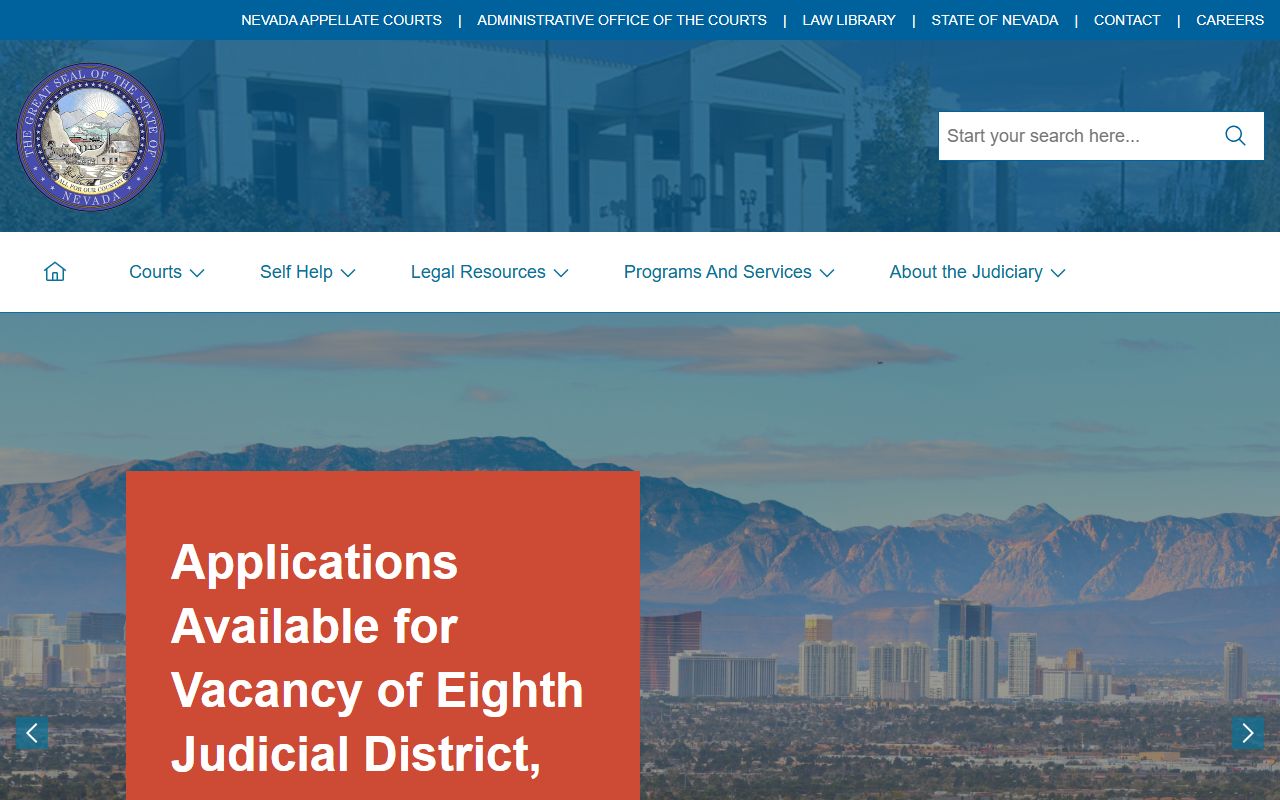
The Nevada Judiciary site at nvcourts.gov covers the appellate courts and their rules. Limited matters from Justice and Municipal Courts may follow their own statutory appeal routes, often to the District Court. Federal cases are separate and move through the U.S. District Court for the District of Nevada and the Ninth Circuit.
History of the Clark County District Court
Clark County was created in 1909, and Las Vegas became the county seat. The court system grew from a small desert county operation into the largest court district in Nevada. The Eighth Judicial District Court now handles the highest-volume urban caseload in the state.
That growth reflects the rise of Las Vegas. Population growth, tourism, gaming, major construction, high-volume marriages and divorces, and regional litigation all feed the court's docket. Downtown Las Vegas became the government and courthouse center, with the Regional Justice Center anchoring District Court operations near the federal courthouse, the detention center, and city hall.
Technology milestones include public online case searching through the Tyler Odyssey Portal, e-filing, and online document purchase. The court continues to balance modern public access with the statutory limits that keep sealed and exempt records out of public view.