
The Clark County Probate Department
Probate in Clark County is handled by the Probate Department of the Eighth Judicial District Court. It is a District Court docket, not a stand-alone county probate court. The department handles wills, estates, administrations, guardianships and conservatorships where assigned, trust disputes, creditor issues, inventories, accountings, letters, and orders.
The image below shows the Eighth Judicial District Court Probate Department page, the official source for Clark County probate procedures and resources.
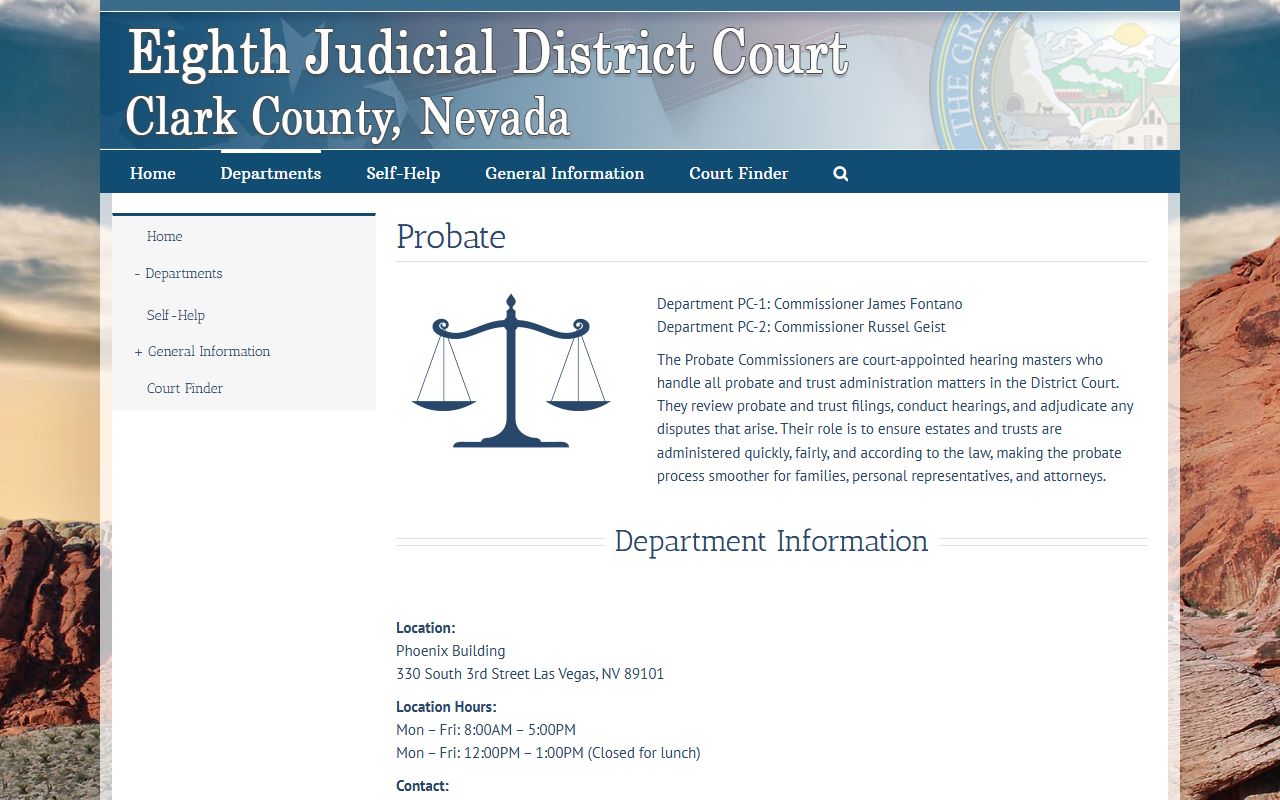
The Probate Department page at clarkcountycourts.us/departments/probate is the right place for current probate procedures, forms, and contacts. Because probate sits inside the District Court, the same Smart Search portal that covers civil and family cases also covers probate cases.
Probate Department
Eighth Judicial District Court
Regional Justice Center
200 Lewis Avenue, Las Vegas, NV 89101
What Clark County Probate Records Cover
Probate records cover the legal process of settling what a person leaves behind and protecting people who cannot manage their own affairs. The records show how an estate moves through the court from the first petition to the final order.
Common Clark County probate records include the petition for probate, the will if one exists, letters testamentary or letters of administration, creditor notices, inventories of estate property, accountings, guardianship and conservatorship filings, trust dispute filings, and the court orders that resolve each step. Each filing becomes a docket entry in the District Court system.
Probate records are public unless restricted. Guardianship matters involving protected persons, minor children, or sensitive financial and medical details may be sealed or redacted. A no-result search may mean the matter is restricted, filed under a different name, or not yet filed.
How to Search Clark County Probate Cases
Probate cases are searched through the Eighth Judicial District Court Smart Search at clarkcountycourts.us/Portal/Home/Dashboard/29. The key step is to select Probate in the Filter by Case Type field. That narrows results to probate matters and filters out civil, criminal, and family cases.
- Open the Smart Search and read the portal notice about sealed and exempt cases.
- Enter a case number or a name in Last, First Middle Suffix format.
- Complete the reCAPTCHA if using anonymous public access.
- Open Advanced Filtering Options and choose Probate in Filter by Case Type.
- Add a file-date range or case status if you need to narrow a large result set.
- Submit the search and open the matching probate case.
- Review the petition, letters, inventory, accounting, and order entries on the docket.
The probate search uses the same field set as the main Smart Search. The court records page lists every field, and the court dockets page covers how to read the docket entries that probate cases produce.
Clark County Probate Record Fields
A probate case in the District Court portal shows a standard set of fields. The table below maps the fields a user is likely to see on a Clark County probate record, with a short note on what each one means.
| Field | What It Shows |
|---|---|
| Case Number | Court identifier for the probate matter. |
| Case Type | Probate, selected in the case-type filter. |
| Case Status | Open, active, closed, or another status value. |
| Filing Date | Date the probate petition was filed. |
| Petitioner / Decedent / Estate | The person filing, the deceased, or the estate name. |
| Judicial Officer | Judge or commissioner assigned to the case. |
| Docket Entries | Petitions, hearings, letters, inventories, and orders in date order. |
| Letters | Letters testamentary or letters of administration, where issued. |
| Inventory and Accounting | Filed estate property inventory and financial accountings. |
| Orders | Court rulings that move or close the estate. |
Note: Sealed or restricted probate documents, especially in guardianship matters, may not appear in a public search.
How Probate Works in Clark County
Probate moves an estate through the court in a series of steps. The exact path depends on the size of the estate and whether a simplified procedure applies under Nevada law. Some small estates qualify for a set-aside or summary process instead of a full formal probate.
- Determine whether a formal probate, set-aside, summary administration, or another simplified procedure applies under Nevada law.
- File the petition in the Eighth Judicial District Court Probate Department.
- Provide notice to heirs, beneficiaries, creditors, and interested parties as required.
- Attend the hearing if one is required.
- The court appoints a personal representative or administrator, or admits the will.
- The representative gathers estate property, gives creditor notice, and files an inventory and accounting.
- The representative pays allowed debts and expenses, then distributes property by court order.
- The estate closes through a final accounting, report, and order.
The Family Law Self-Help Center and the Civil Law Self-Help Center can help self-represented parties with probate-adjacent guardianship and estate questions. The public records page covers requesting copies of probate filings.
Clark County Probate Terms Defined
Probate uses specialized terms. A short glossary helps a searcher read a Clark County probate record without guessing.
- Testator
- The person who made the will.
- Executor
- The person named in a will to administer the estate.
- Administrator
- The person appointed to administer an estate when there is no will or no named executor.
- Intestate
- Dying without a valid will, so state law decides who inherits.
- Letters Testamentary
- The court document that gives an executor authority to act.
- Guardianship
- A court arrangement to care for a person who cannot care for themselves.
- Conservatorship
- A court arrangement to manage the finances of a protected person.
These terms appear throughout a probate docket. Knowing them makes the difference between reading a record and being confused by it.
Nevada Probate Statutes
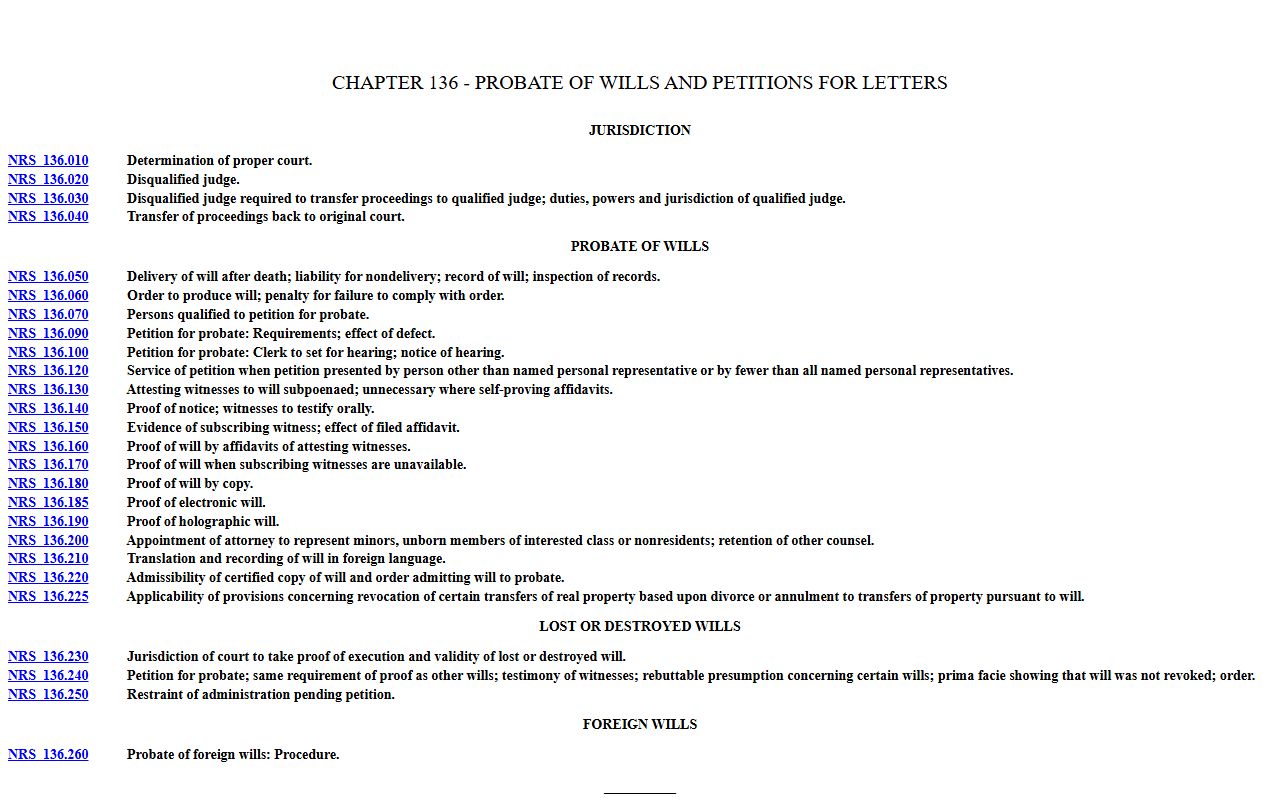
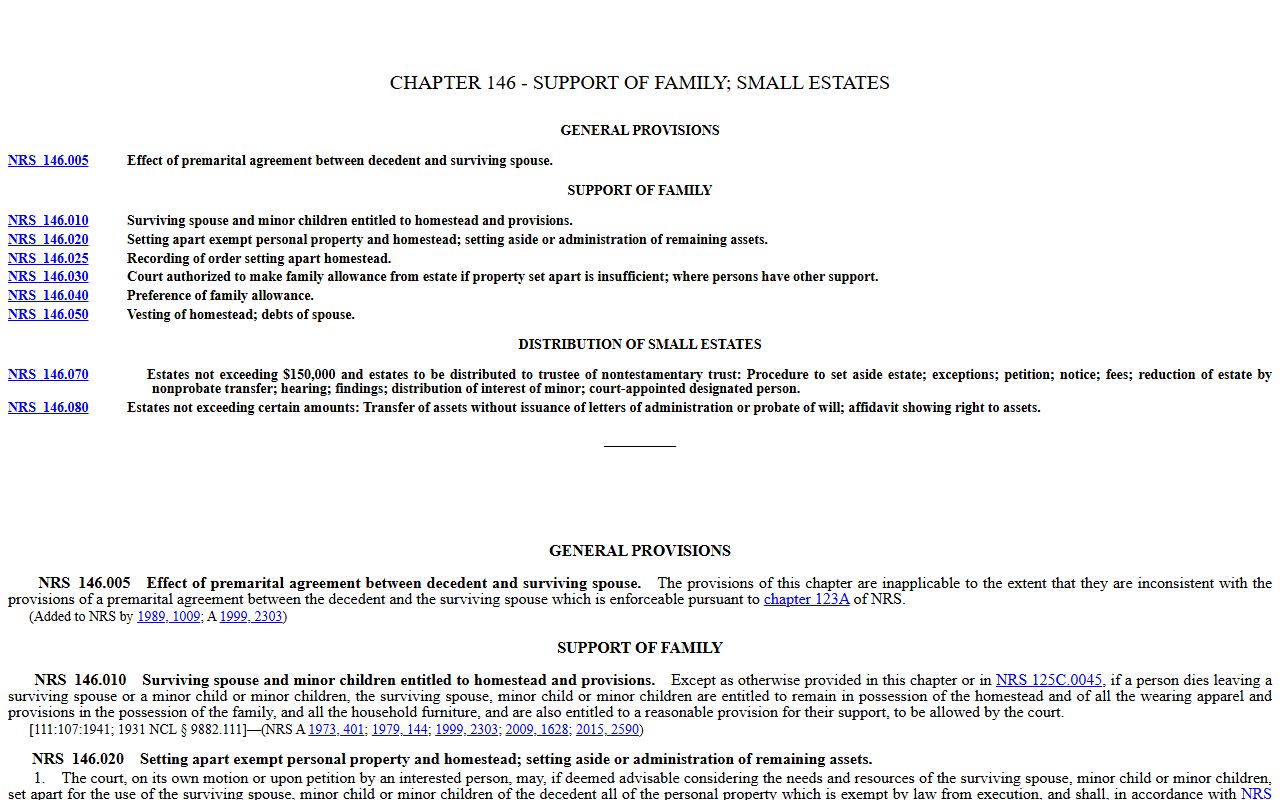
Nevada probate is governed by several statute chapters. Probate of wills and petitions is covered by NRS Chapter 136. Set-aside and support for small estates is covered by NRS Chapter 146. Related chapters cover administration, creditors, inventories, and guardianship.
The image below shows the Nevada probate of wills statute, NRS Chapter 136, which governs Clark County probate filings.
The image below shows the Nevada estate set-aside statute, NRS Chapter 146, used for smaller Clark County estates.
Statutes change with each legislative session. Check the current text at the linked official pages before relying on a specific procedure or threshold.
Confidential Probate and Guardianship Records
Not every probate record is public. Guardianship matters often involve protected persons, minor children, sensitive medical information, and detailed financial data. Courts may seal or redact these records to protect the people involved.
A guardianship file for a minor or an incapacitated adult may show only limited public information. Financial account numbers, medical details, and protected identifiers are redacted from public documents. The court records page covers the broader Nevada framework for restricted and confidential records.
Note: If a probate or guardianship record does not appear in a public search, it may be sealed by court order rather than missing.