
The Nevada Public Records Act in Clark County
Nevada's Public Records Act is found in NRS Chapter 239. The law favors public access. Government records are open unless a statute, court rule, privilege, or confidentiality doctrine makes them closed. The rule applies to Clark County agencies, the Las Vegas Metropolitan Police Department, and other public bodies in the county.
The image below shows the Nevada Public Records Act statute, NRS Chapter 239, which governs Clark County public records access.
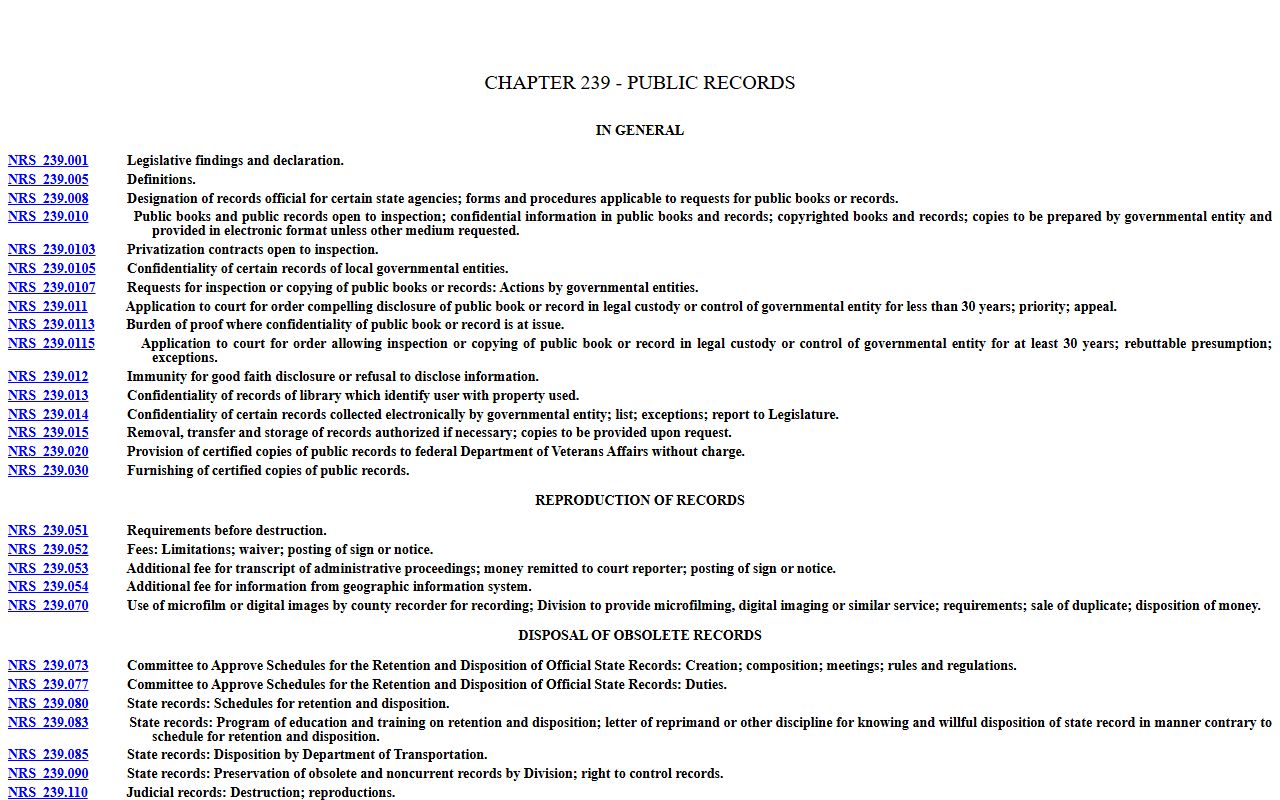
The backbone rule is NRS 239.010, which makes public books and records open unless declared confidential. NRS 239.0107 addresses request handling and agency response timing. NRS 239.052 addresses extraordinary use fees for large or staff-intensive requests. These sections explain why a request is usually granted, why it must be answered within a set window, and why some big requests cost more.
Court Records vs County Records in Clark County
Clark County records split across different offices. Court case files are District Court records, searched through the Smart Search portal and requested from the District Court Clerk. County agency records are requested under the Public Records Act from the agency that holds them. Marriage records and business filings are County Clerk records. The split matters because the request goes to a different office for each type.
A user seeking a court docket uses the Eighth Judicial District Court portal. A user seeking a police report uses the LVMPD records bureau. A user seeking a marriage certificate uses the County Clerk Acclaim system. A user seeking a county agency record, such as a contract or a meeting record, files a public records request with that department.
The court records page covers court case files. The Clark County Clerk page covers marriage and business filings. This page covers the broader public-records request process for county and law-enforcement records.
How to File a Clark County Public Records Request
A public records request in Clark County is sent to the office that holds the record. There is no single county-wide intake for every record. The steps below work for most county and law-enforcement records under the Nevada Public Records Act.
- Identify the office that holds the record. Court files go to the District Court Clerk; police reports go to LVMPD; marriage records go to the County Clerk; agency records go to that department.
- Write a clear request describing the record, including dates, names, case numbers, or report numbers where known.
- Submit the request through the office's designated method, which may be an online form, email, or in-person counter.
- Ask about fees before the office begins work, especially for large or staff-intensive requests.
- Note the response window; the agency must respond within the timeframe set by NRS Chapter 239.
- If access is denied, ask for the statutory basis and consider the statutory remedies and judicial review available under Nevada law.
A narrow, specific request gets a faster answer than a broad one. The more precise the description, the less the office has to search, which keeps fees and delays down.
Clark County Public Records Fees
Fees for Clark County public records are generally limited to statutory or actual-cost categories. Court document purchases and certified copies follow the court or clerk fee schedule. Large or staff-intensive requests may carry an extraordinary use fee under NRS 239.052.
The table below lists the general fee categories a requester may encounter. Confirm the current amount with the office that holds the record, since fee schedules change.
| Fee Category | Notes |
|---|---|
| Plain Copy | Per-page copy charge for non-certified documents. |
| Certified Copy | Higher charge for a copy bearing an official seal. |
| Electronic Document Purchase | Court portal document-purchase fee. |
| Extraordinary Use Fee | Charge for large or staff-intensive requests under NRS 239.052. |
| Marriage Certificate Copy | County Clerk fee for a certified marriage copy. |
Note: Ask for a fee estimate before a large request begins, so a big bill does not arrive as a surprise.
LVMPD and Detention Records in Clark County
The Las Vegas Metropolitan Police Department holds police reports, background checks, and fingerprint records through its Records and Fingerprint Bureau. These are law-enforcement records, requested through LVMPD rather than the court. Detention records, including custody and booking information, come from the Clark County Detention Center.
A police report request usually requires a report number, the date, and the people involved. Some report categories are restricted while an investigation is open. Criminal history repository records are governed by NRS Chapter 179A and follow a separate fingerprint-based process, not a standard public-records request.
The arrest records page covers LVMPD booking and arrest records, and the inmate search page covers detention center custody records.
County Clerk Public Records
The Clark County Clerk holds marriage records, fictitious firm names, notary bonds, and commissioner records. These are searched and ordered through the Acclaim system rather than a court portal. The Clerk also provides general record-search categories for name, instrument, document type, and record date.
The image below shows the County Clerk Acclaim public records search used for Clark County County Clerk records.
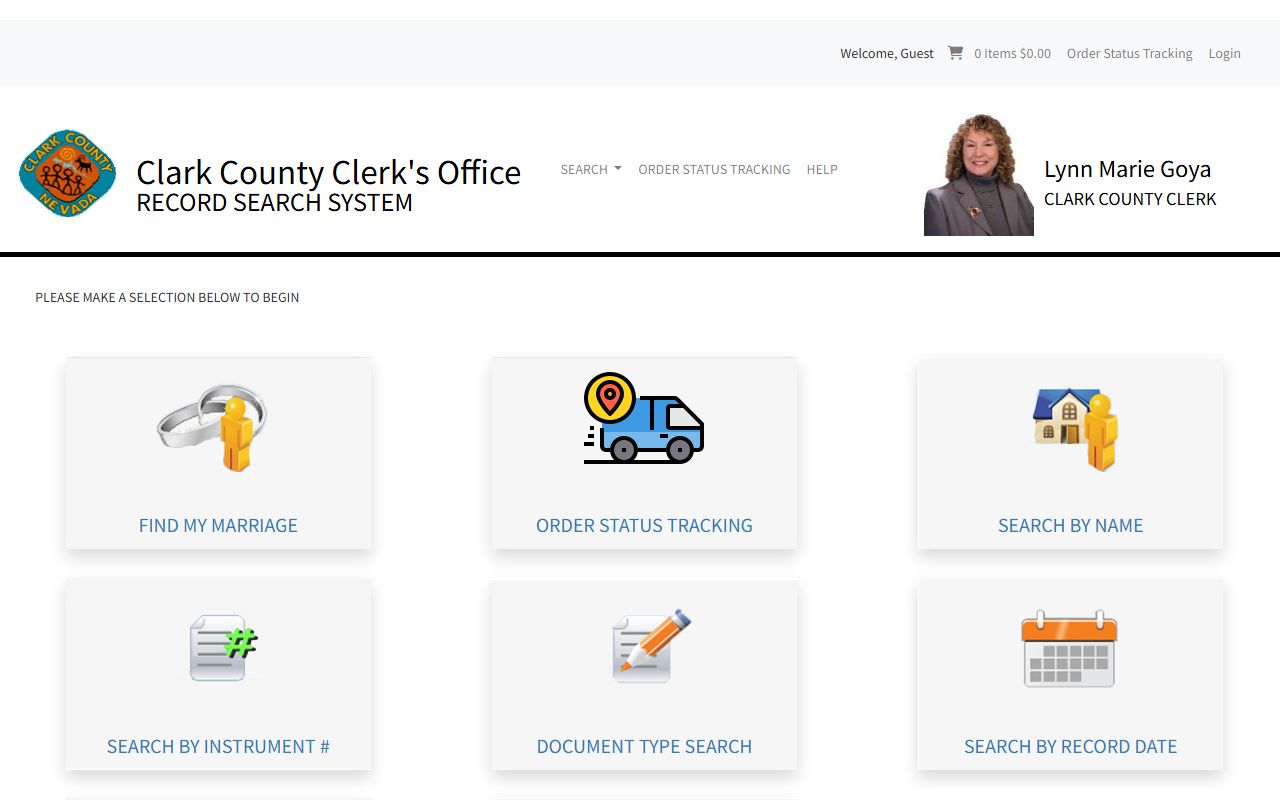
The Acclaim portal at clerk.clarkcountynv.gov/AcclaimWeb supports certified-copy ordering through a cart workflow. The marriage and divorce records page covers the marriage side in detail.
Restricted Clark County Public Records
The Public Records Act has limits. Several record types stay confidential by statute even though the general rule favors access. These restrictions protect privacy, safety, and ongoing investigations.
Juvenile records are restricted under NRS Chapter 62H. Adoption records are confidential under NRS Chapter 127. Child welfare records are restricted under NRS Chapter 432B. Mental-health proceedings are protected under NRS Chapter 433A. Sealed criminal records under NRS Chapter 179 are removed from public access.
Personal identifiers such as Social Security numbers, financial account numbers, and medical details are redacted from public documents. A denial should cite the statutory basis, and the requester can challenge a denial through the remedies Nevada law provides.
Self-Help and Legal Aid for Records Requests
Self-help resources can help a Clark County resident frame a public records request or challenge a denial. These resources provide legal information and forms, not legal representation.
The image below shows the Legal Aid Center of Southern Nevada, a civil legal aid resource for Clark County residents.

The Civil Law Self-Help Center covers civil process, and the Nevada Judiciary Self-Help Center provides statewide forms. Legal Aid Center of Southern Nevada at lacsn.org and Nevada Legal Services at nevadalegalservices.org provide civil legal aid to eligible residents.
Federal Records vs Clark County Public Records
Federal records are not Clark County public records. A federal court case is searched through PACER and the District of Nevada CM/ECF system, not the county portal or a Nevada public-records request. Federal agency records follow the federal Freedom of Information Act, a separate process from the Nevada Public Records Act.
A person who needs a federal court document uses PACER. A person who needs a federal inmate record uses the Bureau of Prisons locator. The court records page covers the difference between state and federal court records in Clark County.
Note: Filing a Nevada public records request for a federal record will not work; use the federal process for federal records.